5 Steps How to Build a Profitable Business with Clothing Bales UK (Easy Guide for Resellers)
Meta Description: Master the math of resale. Learn how to build a profitable business using clothing bales UK, calculate your ROI, and scale from a side hustle to a wholesale powerhouse with Wear It Again.
If you are spending six hours a day scrolling through charity shop rails or fighting for individual bids on eBay, you aren't running a business: you’re working a job that pays less than minimum wage. To move from a "casual reseller" to a professional operator, you need to change your procurement strategy. You need volume, you need consistency, and most importantly, you need to understand the math behind clothing bales UK.
At Wear It Again wholesale, we don’t just sell clothes; we provide the raw materials for your success. In this guide, I’m going to break down the five essential steps to professionalizing your operation, focusing on the numbers that actually matter. It’s time to stop playing small and start scaling.
Step 1: Shift from "Picker" to "Procurement Manager"
The biggest hurdle for most resellers is the emotional attachment to "the find." Finding one vintage Nike sweatshirt for £5 and selling it for £40 feels great, but it’s not scalable. To build a real business, you must transition into the role of a Procurement Manager.
Instead of hunting for individual items, you need to look at wholesale vintage clothing as a commodity. Buying in bulk: using clothing bales UK: allows you to lower your Cost of Goods Sold (COGS) through sheer volume. When you buy a 20kg or 50kg bale, you aren't just buying clothes; you are buying time. You are replacing hours of sourcing with one single delivery to your door.

A professional workspace with organized stacks of wholesale clothing ready for listing.]
Step 2: Master the Math of Profit Margins
Profitability isn't a "vibe"; it’s a calculation. If you don’t know your margins, you don’t have a business. When dealing with bulk vintage clothing, the math is simple but brutal.
Let’s look at a typical 20kg bale.
Purchase Price: £200
Average Item Count: 40-50 items (depending on weight)
Cost Per Item: £4.00 - £5.00
If you sell those items at an average of £15.00 across platforms like Vinted, eBay, or Depop, your gross profit per item is £10.00. After fees and shipping supplies, you are looking at a 2x or 3x return on investment (ROI).
The secret to 3x profit is "The Mix." In every bale, you will have "Home Runs" (items worth £30+), "Bread and Butter" (items worth £15), and "Quick Flips" (items worth £8-10). A professional reseller knows that the "Quick Flips" pay for the bale, and the "Home Runs" are your pure profit. Use our pricing plans to see how bulk buying lowers your entry point and skyrockets your ROI.
Step 3: Implement Rigorous Sorting and Grading
One of the reasons resellers fail with used clothing bales is a lack of discipline during the sorting process. You cannot treat a bale like your personal wardrobe. You need a system.
At our Doncaster-based unit, we pride ourselves on Grade A/B quality with a strict "no-filler" guarantee. However, once that bale arrives at your door, the "Business" part starts with you. You must grade your stock into three categories:
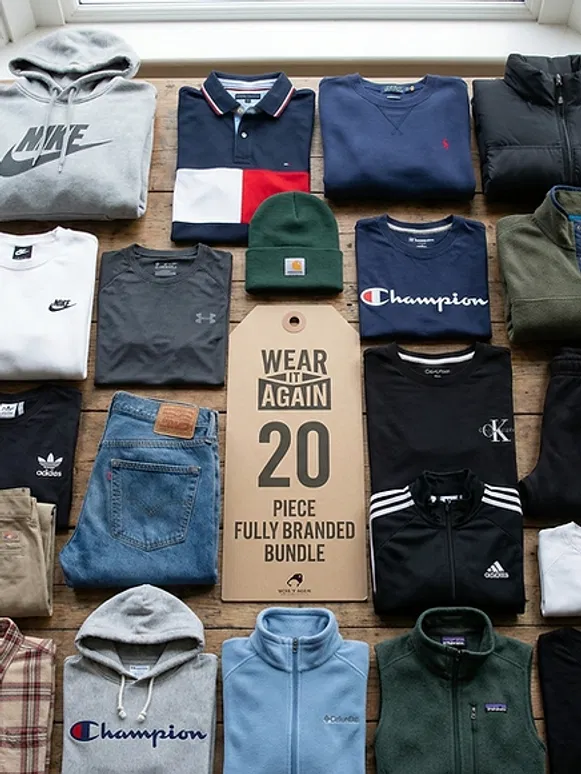
Premium/Exact: High-demand brands (Nike, Adidas, Carhartt) that need high-quality photography.
Standard: Reliable preloved clothing wholesale items that can be listed quickly with template descriptions.
Bundle Stock: Items that are better sold as vintage bundles or "mystery boxes" to move inventory fast.
Efficiency is key here. If you spend 20 minutes photographing a £10 t-shirt, you are losing money. Master the "Flat Lay" or "Mannequin Shot" to keep your listing time under 3 minutes per item.
Step 4: Diversify Your Sales Channels
Relying on one platform is a rookie mistake. To maximize the potential of vintage bales wholesale, you need to be where the buyers are.
Vinted: Best for "Bread and Butter" items and quick flips. Low fees mean more money in your pocket.
Depop: Best for curated vintage wholesale uk finds. If it’s 90s, Y2K, or high-street trendy, list it here for a premium price.
eBay: The global powerhouse. Best for branded staples and specific sizes (XXL+, Tall, etc.).
By spreading your inventory across multiple channels, you increase your "Inventory Velocity": the speed at which your stock turns back into cash. The faster you sell, the faster you can reinvest in your next popular bale.

A digital dashboard showing sales growth across Vinted, eBay, and Depop.]
Step 5: Scale with VIP Precision
Once you have mastered the first four steps, you will hit a ceiling. That ceiling is usually your capital. This is where you move from a side hustle to a legitimate wholesale business.
To scale, you need to lower your overheads. This is why we created the VIP Trade Membership. For a small monthly fee, you unlock 20% off every single order. In the world of wholesale clothing for resellers, a 20% discount isn't just "savings": it’s an immediate 20% boost to your profit margin before you’ve even listed a single item.
Imagine buying a £500 order of reseller clothing bundles. As a VIP, you save £100. That’s enough to buy an entire extra bale for "free." That is how you scale. That is how you dominate your local market and become the go-to seller in your niche.
The Bottom Line: Stop Dreaming, Start Calculating
Building a profitable business with clothing bales UK isn't about luck. It’s about procurement, processing, and profit margins. You have the tools, and you have the supplier. We handle the heavy lifting: sourcing, grading in Doncaster, and ensuring you don't get "filler" junk.
Your job is to implement these five steps. Treat your inventory like an investment portfolio. If an item isn't moving, drop the price and reinvest the capital. If a specific brand is flying out the door, buy an exact bale of it.
The circular fashion economy is booming. In 2026, we’ve already helped our community save 15 tons of clothing from landfills. But more importantly, we’ve helped hundreds of people build businesses that provide real financial freedom.
Are you ready to stop being a hobbyist?
Take Action Today:
Browse our latest 10-20kg sacks.
Join the VIP Membership for a 7-day free trial.
Start calculating your way to a 3x ROI.
Success in the resale world belongs to those who treat it like a business. Let's get to work.
Comments